
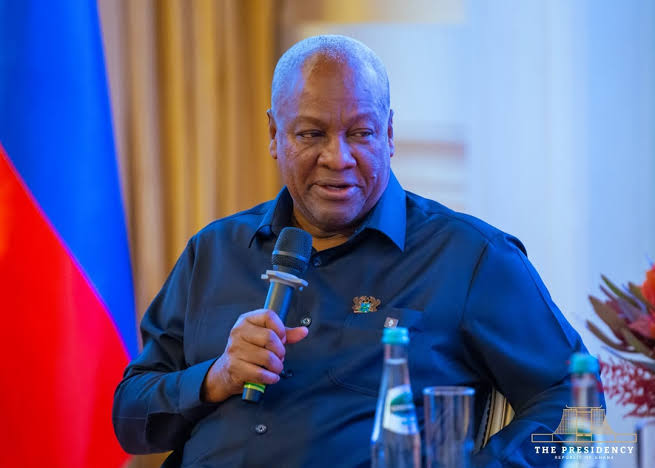
President John Dramani Mahama says Ghana has initiated discussions with Russia’s Rosatom on establishing the country’s first nuclear power station as part of efforts to secure reliable and affordable electricity for industrial development. Speaking at the Russia–Africa Summit, President Mahama said Ghana was pursuing a diversified energy mix that includes renewables while advancing preparations for the peaceful use of nuclear energy.
“Industrialisation requires reliable and affordable electricity,” he said. “We have initiated discussions with Rosatom on the establishment of Ghana’s first nuclear power station.”
President Mahama identified inadequate electricity supply as a major obstacle to Africa’s progress, describing energy as an area where cooperation between Russia and African countries could deliver tangible results. He highlighted opportunities for collaboration in renewable energy and nuclear power, linking reliable electricity supply to Ghana’s industrial ambitions.
The President also referred to Ghana’s longstanding relationship with Russia in the peaceful use of nuclear energy, including the training of Ghanaian nuclear scientists in Russia.
Turning to agriculture, President Mahama said Russia’s experience in fertiliser production, agricultural machinery and scientific research offered opportunities for practical cooperation. “Reliable supplies of fertiliser at competitive prices would help our farmers plan with greater confidence,” he said.
He added that investment in local fertiliser production and blending would strengthen agricultural resilience. President Mahama also identified soil mapping, precision agriculture and satellite information as areas of potential collaboration to help farmers improve planting decisions and the application of agricultural inputs. “Technology becomes valuable when it helps a farmer make better decisions, lowers his costs and protects his harvest,” he said.
President Mahama also called for Africa to play an active role in shaping the development and use of artificial intelligence. He said the technology was changing how economies produce, governments deliver services and people learn. “Africa must help shape this transformation and develop the skills and infrastructures needed to benefit from it,” he said.
Leave a Comment