
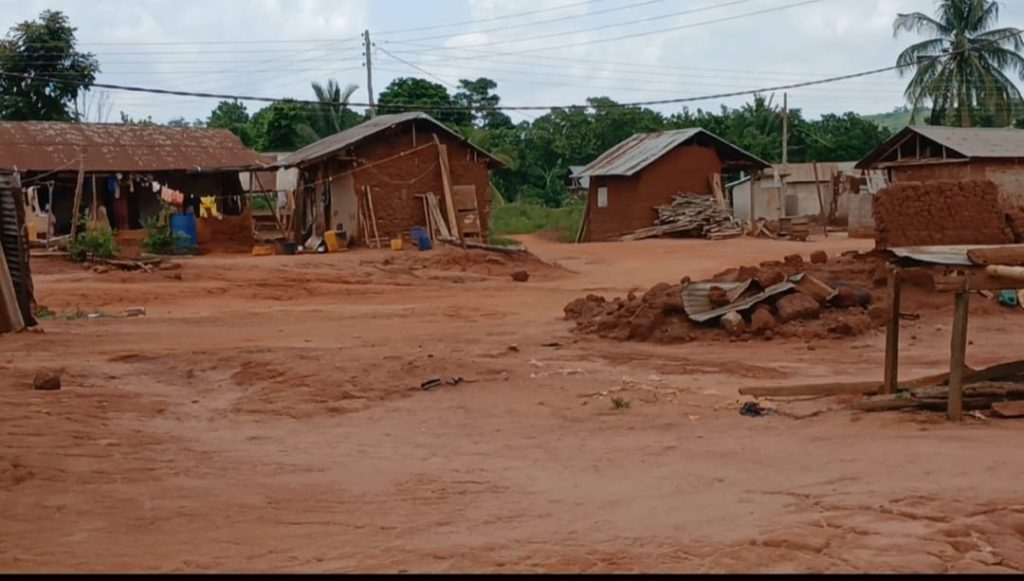
Residents of Akonkonti in the Techiman North District are calling for urgent government intervention over the lack of basic social amenities, particularly motorable roads and access to healthcare.
For the people of this farming community, poor road conditions remain one of their biggest challenges. The 30-minute journey from Boayem to Akonkonti has become a difficult and exhausting experience. Deep potholes, uneven surfaces, and thick dust make travel uncomfortable and, at times, unsafe. Motorcycles and tricycles are the only means of transport for both residents and farm produce.
During the rainy season, the situation worsens significantly. Roads become nearly impassable, leading to delays and financial losses for farmers. One farmer, Alfred, lamented that perishable goods often spoil before reaching the market, resulting in lost investments. “During the harvesting of tomatoes, we sometimes find it difficult to transport them to the market due to the poor road conditions, and as a result, the tomatoes get spoiled,” he said.
Healthcare access is another major concern. The absence of a clinic or CHPS compound forces residents to travel to neighboring communities for medical care. Dora Asigri, a resident, shared that pregnant women are sometimes forced to give birth while en route to health facilities due to the long distances and poor roads. She emphasized, “We take patients and pregnant women to Buoyem; we have no clinic here, and sometimes the pregnant women end up giving birth while traveling. There are a lot of complications, but we managed.”
Although the community has access to clean water, residents say the only available source is insufficient, leading to periodic shortages. “We all depend on one tank that supplies us with water; they say it cannot be connected to our house due to the meter. We often experience water shortages,” they added.
Education is also being affected. While Akonkonti has a school, both teacher and student attendance drop sharply during the rainy season because of the poor road network. The lack of teachers’ accommodation further worsens the situation, as educators are unable to stay in the community. Parents fear their children are falling behind academically, as syllabi are often left incomplete.
Housing conditions in the community are equally concerning. Nearly 90 percent of homes are built with mud, many of which show visible cracks or are reinforced with wooden supports. While residents have adapted to these conditions, they acknowledge the potential risks.
Residents say without immediate government intervention, the challenges facing Akonkonti will persist, with the risk of worsening living conditions and potential disaster looming.
Leave a Comment